A concise technical overview of the current scoring framework used by Ignatius Journal Services.
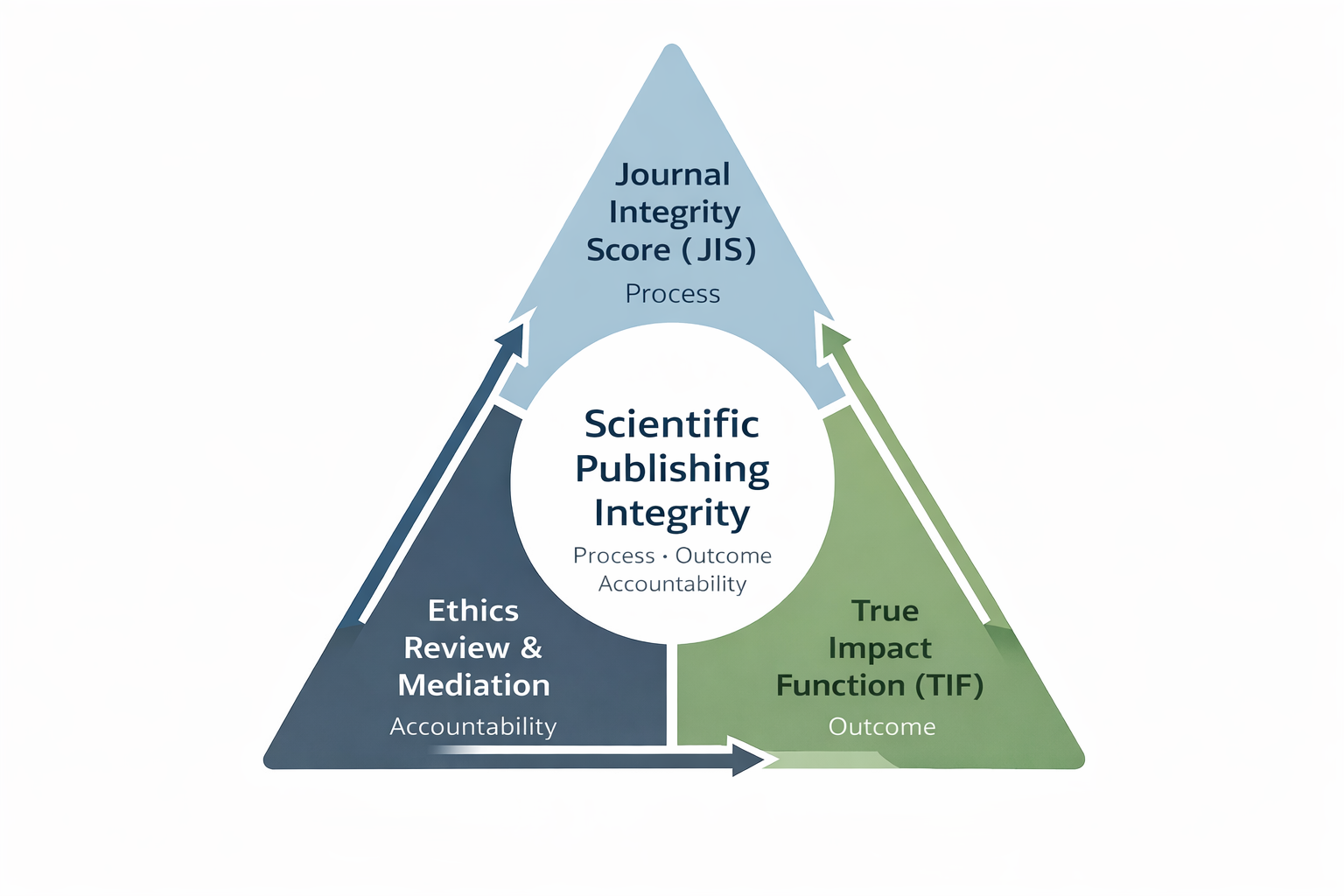
The IJS model evaluates journals using a three-component framework: citation dynamics, editorial integrity, and transparency and accountability. These are represented by the True Impact Function™ (TIF), the Journal Integrity Score™ (JIS), and a supporting layer that includes data verification, independent mediation, and a living repository of journal evaluations.
The Journal Integrity Score™ (JIS) is a binary code consisting of seven bits, or pillars. Each pillar receives either a binary 1 when the journal meets the stated criterion or a binary 0 when it does not. The sum of the seven bits can also be reported to show the cumulative score.
| Pillar | Ideal state - binary 1 | Non ideal state - binary 0 |
|---|---|---|
| 1 Retractions | Zero retractions in the prior 12 months | One or more retractions in the prior 12 months |
| 2 Formatting | Standard scientific structure without rigid proprietary rules | Substantial stylistic or proprietary formatting burden |
| 3 Limits | No arbitrary word, figure, or table limits that constrain scientific clarity | Meaningful restrictions imposed |
| 4 Forms | No redundant manual metadata re-entry at initial submission | Substantial manual re-entry of manuscript data |
| 5 Speed | Mean time to first decision ≤ 21 days | Longer mean time to first decision |
| 6 Copyright | Author-retained copyright / open license model | Copyright transfer or comparably restrictive arrangement |
| 7 Cost | Article processing charge (APC) = $0 | Any material APC burden |
The current JIS model is intentionally simple and transparent. A later version can incorporate partial credit within pillars rather than using only all-or-none scoring. Transparent policies regarding the use and disclosure of artificial intelligence in manuscript preparation are encouraged as part of ethical editorial practice. Formal Methodology Paper (JIS). ⬇️ PDF
The True Impact Function™ (TIF) uses the CAT equation. Here, C is the total number of citations accumulated by the analyzed article set from the index year to the analysis date, A is the number of articles in that set, and T is the mean elapsed time since publication for those articles in units of years. TIF enables near real-time assessment of citation velocity, avoiding the multi-year lag inherent in traditional impact metrics. Though not part of the CAT equation, the index year and the analysis date are additional required reporting parameters so that every calculation remains interpretable and reproducible. Formal Methodology Paper (TIF). ⬇️ PDF
New journals do not need to wait for legacy indexing cycles - which typically takes 3 years - before reporting whether their papers are being used and cited.
Normalizing by article count and elapsed time reduces distortion from publication-date timing and from single highly cited outliers.
OpenAlex–based workflows intentionally capture citations from non-traditional works such as preprints, theses, and other scholarly venues beyond narrower commercial databases.
The transparency and accountability layer supports the TIF and JIS by ensuring that data sources are verifiable, disputes can be independently reviewed, and journal evaluations are continuously updated. This includes:
High citation activity alone does not mean that a journal is fair to authors. Pairing TIF with JIS provides both an outcome measure and a process measure.
Showing TIF alongside Journal Impact Factor or SCImago-style measures helps readers understand where citation velocity agrees with—and diverges from—older systems.
Journal Integrity Score™ (JIS) and True Impact Function™ (TIF) are proprietary analytical frameworks developed by Ignatius Journal Services.