A scholar-led framework for transparent journal evaluation, author-centered publishing standards, and accountable editorial practice.
Ignatius Journal Services™ (IJS) was established to advance transparency, accessibility, and integrity in scholarly publishing. It provides a framework for evaluating journals not by prestige alone, but by measurable characteristics that affect both the dissemination of knowledge and the experience of authors.
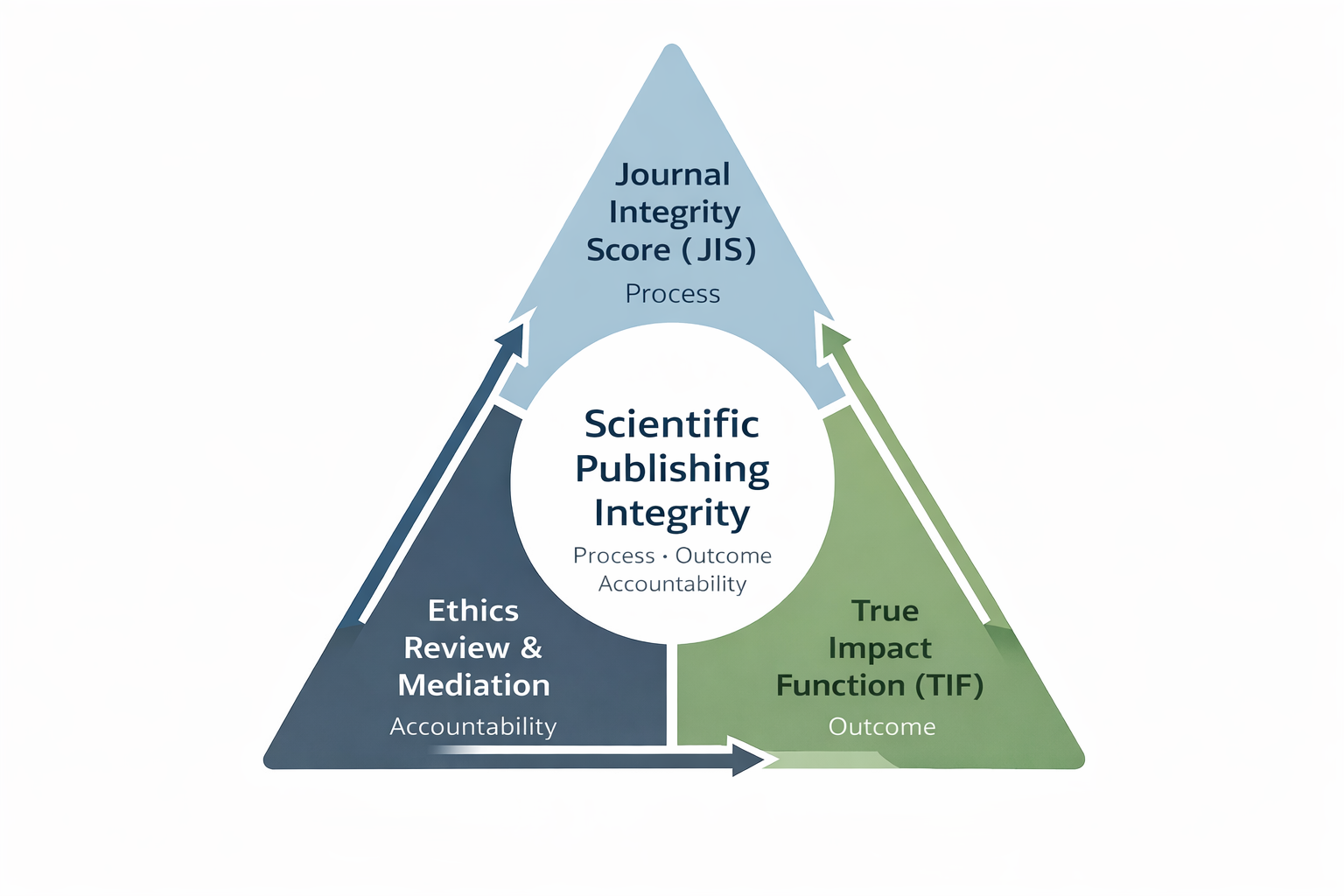
At its core, IJS introduces a three-component framework consisting of the True Impact Function™ (TIF), the Journal Integrity Score™ (JIS), and a Transparency and Accountability Layer. Together, these elements provide a clear, reproducible, and continuously updated assessment of journal performance and publishing conditions.
The TIF quantifies journal influence as a time-normalized citation rate, enabling real-time evaluation of citation velocity rather than reliance on delayed annual summaries alone.
The JIS evaluates journals across seven author-relevant dimensions, including accessibility, submission burden, review speed, copyright, and cost.
A structured layer incorporating data verification, independent mediation, and a living repository, ensuring that journal evaluations remain transparent, reproducible, and continuously updated.
The True Impact Function™ (TIF) and Journal Integrity Score™ (JIS) are proprietary analytical frameworks developed by Ignatius Journal Services.
The True Impact Function™ (TIF) quantifies journal influence as a time-normalized citation rate. Unlike conventional metrics that rely on fixed historical windows, TIF incorporates elapsed time since publication, enabling real-time assessment of citation velocity. It is defined as citations per article per year and can be calculated at any time using openly available bibliographic data.
In this way, TIF complements conventional bibliometric systems while addressing a central limitation of delayed reporting: recently influential work becomes visible more quickly, and journals can be compared using a metric that reflects current citation dynamics.
The Journal Integrity Score™ (JIS) evaluates journals across seven dimensions relevant to authors, including submission requirements, turnaround time, accessibility, and cost. Expressed as a binary code, JIS serves as a transparent and interpretable summary of the practical conditions under which scholarly work is reviewed and published.
The score is intentionally straightforward. Its equal weighting supports interpretability and reproducibility, while future refinement remains possible as additional data and experience accumulate.
Ignatius Journal Services is an independent, nonprofit initiative established to promote fairness, transparency, and measurable integrity in scientific publishing. It is grounded in the principle that scientific publishing should reflect the same standards of rigor and integrity expected of scientific work itself. The initiative is inspired by a philosophy that values clarity over convention, substance over formality, and fairness over institutional inertia.
IJS is not intended to replace existing bibliometric systems, but rather to complement them by addressing aspects of publishing that are often underrepresented—particularly those affecting accessibility, efficiency, and author autonomy. In this regard, the framework places special emphasis on Diamond Open Access, in which scholarly work is free to publish and free to read, and barriers to dissemination are minimized.
This emphasis reflects a broader conviction that the scientific record is strengthened when authors can communicate their work without unnecessary financial obstacles, excessive procedural burden, or avoidable delays in review and publication.

Ignatius Journal Services is named in honor of
Edward Ignatius Ciaccio, PhD, whose commitment to rigor, clarity, and intellectual honesty inspire the mission.
🌐Webpage
Beyond metric development, IJS serves as a scholar-led data repository. Researchers are invited to contribute TIF calculations and JIS assessments across disciplines. Submissions are reviewed for methodological consistency prior to inclusion, with the long-term objective of building a comprehensive, openly accessible database of journal characteristics.
This model is intended to keep the framework open, low-cost, and continuously useful. It also preserves a central value of the project: that evaluation standards in scholarly publishing should remain visible, discussable, and open to principled refinement.
In addition, IJS supports a model of collegial and efficient peer review, emphasizing constructive evaluation, transparency, and timely decision-making. For manuscripts authored by members of an Editorial Board, independent external review is incorporated to help ensure objectivity. This hybrid approach is intended to preserve both rigor and efficiency in the review process.
The guiding principle of Ignatius Journal Services is that scholarly publishing should prioritize the dissemination of knowledge over procedural or financial barriers. By providing tools for real-time assessment and transparent evaluation, IJS seeks to enable investigators to focus more fully on research itself, and less on navigating the complexities of publication.