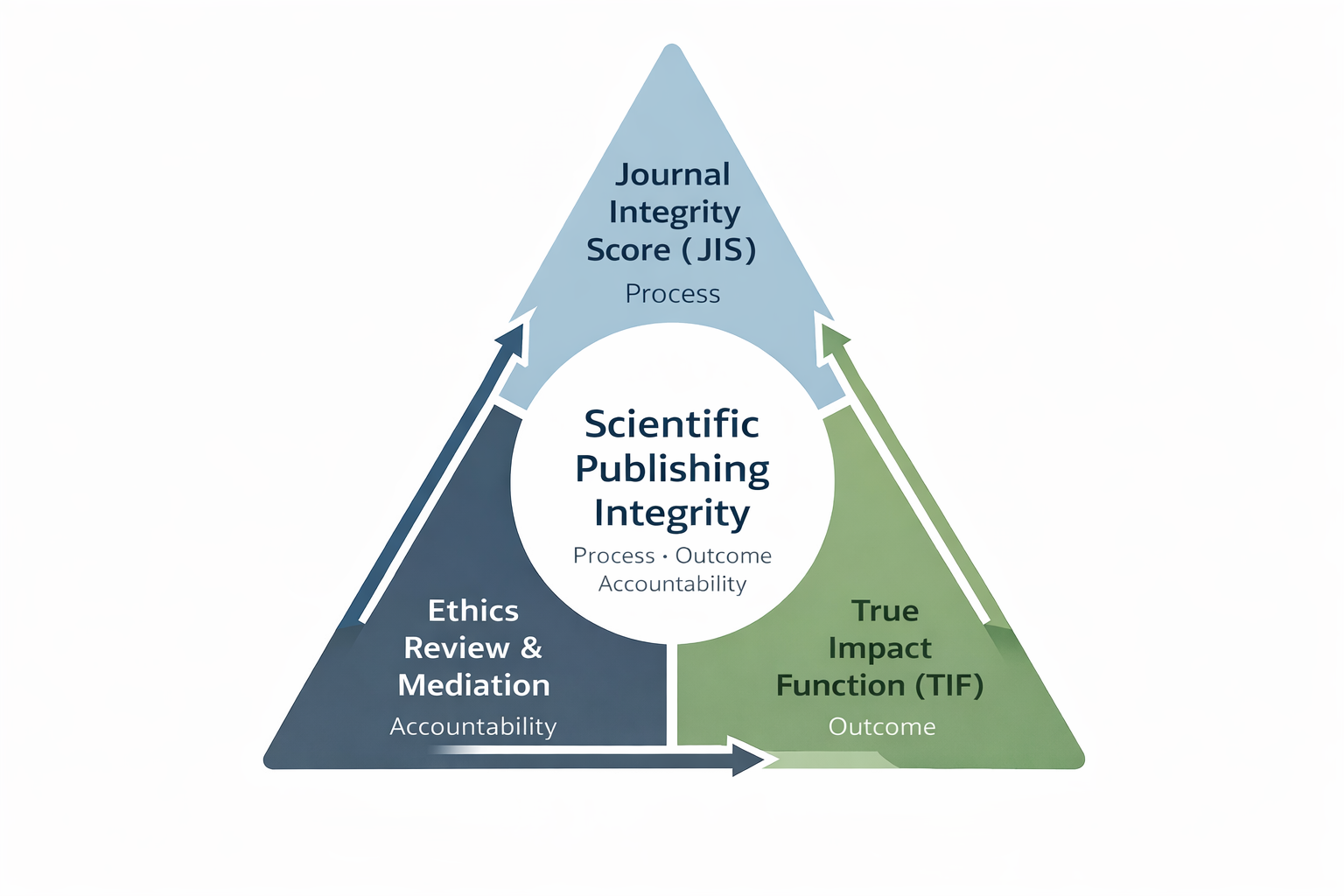
Foundational concepts behind the Journal Integrity Score™, the True Impact Function™, and independent ethics review.
Edward J. Ciaccio, PhD
🌐https://columbia.edu/~ejc6Scientific publishing remains heavily shaped by legacy evaluative systems that undermeasure author burden, publication fairness, and accountability. Ignatius Journal Services™ proposes a complementary framework built on three parts: the Journal Integrity Score (JIS), which evaluates author-relevant and integrity-relevant journal practices; the True Impact Function (TIF), which quantifies annualized citation velocity through a transparent formula; and a proposed independent ethics review pathway for disputes that internal systems do not resolve fairly. Together, these elements are intended to provide a clearer and more actionable view of journal quality than citation prestige alone.
Citation prestige alone does not reveal whether a journal is fast, fair, transparent, affordable, or respectful of author rights. Nor does it provide a neutral mechanism for addressing editorial disputes when conflicts of interest or institutional asymmetries are present. A more complete framework should therefore assess both how journals behave and how published work circulates.
The JIS evaluates seven author-relevant and integrity-relevant pillars: retractions, formatting burden, limits, submission forms, editorial speed, copyright policy, and APC burden. The current version is intentionally simple. Each pillar is scored as a binary value of 1 for the ideal state and 0 otherwise; the bits can also be summed as a combined score with a maximum value of 7. This structure favors interpretability and invites later refinement rather than hiding judgment inside a black box.
The TIF is calculated by the CAT equation, TIF = C / (A × T), where C is total citations, A is the number of analyzed articles, and T is the mean elapsed time since publication in years for those articles. The index year and analysis date must also be reported. This formulation is especially useful for new or specialized journals because it can reflect emerging traction before multi-year legacy indexing systems fully recognize that activity.
Publishing disputes frequently involve asymmetries of power between authors and journals. IJS therefore proposes a structured pathway for external, nonbinding review that emphasizes documentary evidence, technical substance, and proportionality. The goal is not to supplant journals, but to create a transparent venue for reasoned scholarly review when conventional internal channels have reached an impasse.
Together, JIS and TIF provide a more complete view of journal value than either process measures or citation measures alone. Coupled with independent mediation, they offer a path toward a publishing ecosystem that is more transparent, more accountable, and more intelligible to the researchers it serves.